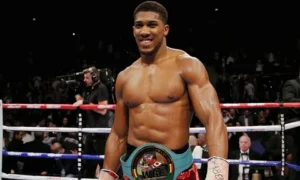
Look, as I’m writing this on December 19, 2025, Anthony Joshua is literally about to step into the ring in Miami to fight Jake Paul. This is happening tonight. So by the time you read this, the outcome might already be known. But let me tell you about the journey that brought AJ to this moment—because the Anthony Joshua bio is one of the most remarkable transformation stories in modern sports.
This is about a kid who went to prison at 19, who was headed down a dark path, who discovered boxing almost by accident—and became Olympic gold medalist, two-time unified heavyweight champion, and one of the biggest names in British sports history. This is about a British-Nigerian athlete who’s never forgotten his roots, who represents both cultures with pride, and who’s faced incredible highs and devastating lows in the brutal world of heavyweight boxing.
So let’s talk about Anthony Joshua—where he came from, how he got here, and why tonight’s fight against Jake Paul (yes, that Jake Paul) might be one of the strangest chapters yet in his already incredible story.
The Beginning: Born in Watford, Raised Between Two Worlds
Anthony Oluwafemi Olaseni Joshua was born on October 15, 1989, in Watford, Hertfordshire, England. His mother, Yeta Odusanya, is Nigerian. His father, Robert Joshua, has both Nigerian and Irish ancestry. That middle name—Oluwafemi—is pure Yoruba, and it connects him to Nigerian royalty. Joshua’s Nigerian background can be specifically traced back to the Yoruba people, amongst whom he is of aristocratic rank.
So yeah, British boxing’s biggest star is actually a Nigerian prince. How’s that for a backstory?
The Nigeria Years
Here’s what most people don’t know: Joshua spent significant parts of his childhood in Nigeria. He attended Mayflower School in Ikenne, Ogun State, as a boarding school student.
Imagine being a kid shuttling between Watford, England, and Ogun State, Nigeria. Two completely different worlds. Two cultures. Two ways of life. That experience shaped who AJ became—someone who’s equally comfortable in both places, who represents both proudly.
The Divorce and Return to England
When Joshua was 12, his parents divorced. Following his parents’ divorce when he was 12, he returned to the UK halfway through Year Seven to join Kings Langley Secondary School.
He grew up on the Meriden Estate in Garston, Hertfordshire—a council estate, working-class neighborhood. His friends called him “Femi” (short for his middle name Oluwafemi), not Anthony.
And here’s something that hints at his athletic potential: He excelled at football and athletics and broke his school’s Year Nine 100m record with a time of 11.6 seconds.
11.6 seconds at 13-14 years old? That’s fast. Really fast. The kid had natural athletic ability that was obvious to everyone.
The Dark Period: Prison and the Crossroads
But despite that athletic talent, Joshua’s teenage years took a dark turn. This is the part of the Anthony Joshua bio that he’s been open about, and it’s crucial to understanding his journey.
2009: Reading Prison
At 19 years old, in 2009, Joshua was put on remand in Reading Prison for what he describes as “fighting and other crazy stuff.”
He’s never gone into full detail about exactly what happened, but he was incarcerated. A teenager in prison, facing a future that looked bleak. When he was released, he was made to wear an electronic tag on his ankle.
This wasn’t just a brush with the law—this was a genuine crossroads moment. One path led to more violence, more crime, potentially more prison. The other path? That required finding something to channel his energy, his anger, his athleticism into something constructive.
The Cousin Who Changed Everything
Enter his cousin, Ben Ileyemi (who’s also a professional boxer). Ben introduced Joshua to boxing when he was 18, bringing him to Finchley Amateur Boxing Club in North London.
At 18, Joshua was a bricklayer by trade. He was working construction, had been in trouble with the law, and wasn’t on any particular path to success. Boxing wasn’t even on his radar.
But something clicked when he put on the gloves. His raw talent and physical strength made him stand out immediately. Here was a kid who was 6’6″, athletic, powerful, and had natural timing. Coaches saw it instantly.
Along with his boxing ability, this has been attributed to his “rags to riches” story, enforcing a narrative that he avoided a life of violence and crime by dedicating himself to boxing.
The Amateur Years: Rising Fast
What’s remarkable about Joshua’s boxing career is how late he started compared to most elite fighters. Most world champions start boxing at 8, 10, 12 years old. Joshua started at 18.
But he rose through the ranks incredibly fast.
2010-2011: National Success
Within just a couple of years, Joshua was winning national amateur titles. In 2011, he won a silver medal at the World Amateur Boxing Championships in the super-heavyweight division.
Silver at Worlds in just his third year of boxing? That’s absurd progression.
2012: Olympic Gold
Then came the moment that changed everything: the 2012 London Olympics.
Great Britain hosted the Olympics, and Joshua was part of the boxing team. He competed in the super-heavyweight category (+91kg), and the nation watched as this charismatic, powerful fighter demolished opponents.
In 2012 London Olympics, Joshua won gold medal in the super-heavyweight category, becoming a national hero in Britain and a pride of Nigeria.
That gold medal made him a star overnight. He wasn’t just another boxer—he was an Olympic champion who’d won on home soil. He had the look (imposing physique, handsome), the personality (articulate, charismatic), and the performance (brutal knockouts).
Turning Pro: The Perfect Start
In 2013, Joshua turned professional. And what followed was one of the most dominant starts to a professional boxing career in heavyweight history.
Joshua turned professional in 2013. Won his first 22 fights, many by knockout, gaining a reputation as one of the most dangerous heavyweights.
Let me put that in perspective: 22-0. Twenty-two straight wins. Most by knockout. He was demolishing opponents, often in the first few rounds.
His knockout-to-win ratio stands at an impressive 91%, underscoring his formidable power in the ring.
91%! That’s video game numbers. That’s Mike Tyson-in-his-prime territory.
2015: British and Commonwealth Champion
By 2015, just two years into his pro career, Joshua won the British and Commonwealth heavyweight titles by defeating Dillian Whyte in a brutal war at The O2 Arena in London.
That Whyte fight showed something important: Joshua could not only knock people out early, but he could also survive adversity. Whyte dropped him in round two. Joshua had to dig deep, and he came back to stop Whyte in round seven.
2016: IBF World Champion
In 2016—just three years pro—Joshua won his first world title, stopping Charles Martin in two rounds to claim the IBF heavyweight championship.
He was 26 years old and a world champion. The meteoric rise was complete.
2017: The Klitschko Fight That Made Him a Legend
If there’s one fight that defined early-career Anthony Joshua, it’s the one that happened on April 29, 2017, at Wembley Stadium.
2017: Defeated Wladimir Klitschko in a legendary bout at Wembley Stadium in front of 90,000 fans, adding the WBA (Super) and IBO titles.
90,000 people. Wembley Stadium. Wladimir Klitschko—the legendary Ukrainian champion who’d dominated heavyweight boxing for a decade.
The Fight
This wasn’t just a coronation. This was a war.
Joshua knocked Klitschko down in round five. Klitschko got up and knocked Joshua down in round six. The stadium exploded. Was the young champion about to lose?
But Joshua dug deep, survived, and came roaring back. In round eleven, he stopped Klitschko with a devastating assault.
It was named Fight of the Year. It was an instant classic. And it cemented Joshua as not just a champion, but a superstar.
The Unified Champion: Collecting Belts
After Klitschko, Joshua added the WBO belt in 2018, becoming the unified heavyweight champion—holding the IBF, WBA, WBO, and IBO titles simultaneously.
He defeated Alexander Povetkin, Dominic Breazeale, and Joseph Parker. He was clearing out the division. At this point, Joshua looked unstoppable. People were talking about him going down as an all-time great.
And then came June 1, 2019, at Madison Square Garden in New York.
2019: The Shocking Ruiz Loss
Anthony Joshua vs. Andy Ruiz Jr. was supposed to be a showcase. Ruiz was a last-minute replacement opponent. Joshua was making his American debut at the iconic Madison Square Garden. This should have been easy.
In the third round, Joshua dropped Ruiz. Good, everyone thought, this is going as expected.
Then Ruiz got up and started landing. And landing. And landing.
Ruiz dropped Joshua in round three. Then again in round seven. Four times total. The referee stopped it. New champion: Andy Ruiz Jr.
The boxing world was stunned. Joshua’s father, Robert, was at the fight and actually got into a confrontation with Joshua’s promoter after the loss.
The Rematch: Redemption
Six months later, in December 2019 in Saudi Arabia, Joshua got his rematch. This time he boxed smart, stayed on his bicycle, used his jab, and won a clear unanimous decision to reclaim his titles.
But something had changed. The aura of invincibility was gone. Joshua had shown he could be hurt, could be stopped.
The Usyk Era: Painful Losses
In September 2021, Joshua faced Ukrainian pound-for-pound great Oleksandr Usyk for the unified heavyweight titles.
Usyk—a former undisputed cruiserweight champion moving up—outboxed Joshua over twelve rounds, winning a clear unanimous decision. Joshua lost his belts again.
The Rematch and the Bizarre Speech
In August 2022, they fought again in Saudi Arabia. Joshua fought better this time, was more competitive, but Usyk still won by split decision (115-113 for Joshua on one card, but 115-113 and 116-112 for Usyk on the others).
Then came one of the strangest moments in boxing history.
After the announcement of the judges’ scorecards, Joshua threw two of Usyk’s belts out of the ring and started to walk out of the arena, but came back and once in control of the microphone gave an emotional speech.
He started rambling about his life, about not getting opportunities, about critics comparing him to Rocky Marciano (a much smaller fighter), about Ukraine and war. It was bizarre, raw, emotional—and uncomfortable to watch.
Onlookers were surprised and didn’t seem to know how to act when Anthony gave his unusual speech.
Backstage, he was recorded yelling at someone: “Who are you talking to? Who are you talking to? Shut your fucking mouth.”
In the post-fight press conference, Joshua broke down in tears.
It was clear: the losses were taking a psychological toll.
The Comeback Trail: New Trainer, New Approach
After the second Usyk loss, Joshua made changes. In February 2023, he announced a new partnership with American trainer Derrick James, one of the best coaches in boxing.
He also signed an exclusive five-year deal with streaming service DAZN.
His return fight was in April 2023 against Jermaine Franklin at The O2 Arena. Joshua won a unanimous but uninspiring decision. It wasn’t the statement people hoped for.
Then came September 2024.
September 2024: The Dubois Knockout
On September 21, 2024, Joshua faced Daniel Dubois at Wembley Stadium for the IBF heavyweight title (which had become vacant).
This was supposed to be Joshua reclaiming glory at Wembley, five years after his Klitschko triumph in the same venue.
Instead, Dubois knocked him out in the fifth round with a devastating right hand. It was brutal, conclusive, and raised serious questions about whether Joshua’s best days were behind him.
He’s now 28-4 as a professional. Four losses. Three knockout losses (Ruiz, Dubois, and one other